

Why Natural Language is the only interface that scales the human mind—and AI models
The clock has ticked over to a new year. The ball dropped, and the year 2026 is upon us. While we were spending time with family and making resolutions, threats were evolving. Without a doubt, the threat landscape of 2026 is fast, AI-augmented, automated, and more fragmented than ever before.
For the last decade, we have asked our SOC analysts to fight this war with one hand tied behind their backs. We forced them to be machine linguists first and investigators second. We demanded they memorize SPL, KQL, SQL, and a dozen other proprietary syntaxes just to ask a simple question:
"Is this bad?"
Let’s make 2026 the year, when we put a stop to that. The most powerful interface for the modern SOC isn't a new dashboard or a code block. It is the question mark!?
Questions: The Human Way to Inquire
There is a reason the Socratic method has survived for 2,400 years: The human brain is wired for inquiry, not query.
Research into cognitive learning modalities consistently shows that Question Generation produces deeper cognitive engagement than passive consumption or rote translation. When an analyst must translate their suspicion into complex code—figuring out the correct JOIN query or timestamp format—their cognitive load shifts from intellectual analysis (investigation strategy) to implementation (syntax). They stop hunting the threat and start debugging the query.
Decades of educational psychology research, such as studies on the "Doer Effect" and active recall, demonstrate that humans retain information and solve problems faster when they ask questions rather than just passively reading logs or translating commands. By shifting the interface to Natural Language Query (NLQ), we remove that friction. We allow all SOC analysts to operate with the speed of thought.
"It's not enough to just provide the query. We need to ask those questions for them, driving deeper investigations... This significantly reduces the 'grunt work,' allowing human analysts to focus on higher-level analysis." — Dov Yoran, Co-Founder & CEO, Command Zero This notion of asking human questions lies at the heart of the Command Zero platform. The platform comes with a pre-built set of investigative questions that can be used by human analysts and AI agents to deliver the best analysis in a predictable, auditable and repeatable way. SOC teams can build their own custom questions and add custom data sources to fine tune the platform to their environment’s context and needs. Questions serve as building blocks for threat hunting and analysis. Chaining questions in desired sequences help operationalize expertise and ensure repeatability.
Operationalizing Expertise: Introducing Facets
To bridge the gap between simply "asking a question" and conducting a rigorous investigation, Command Zero provides Facets.
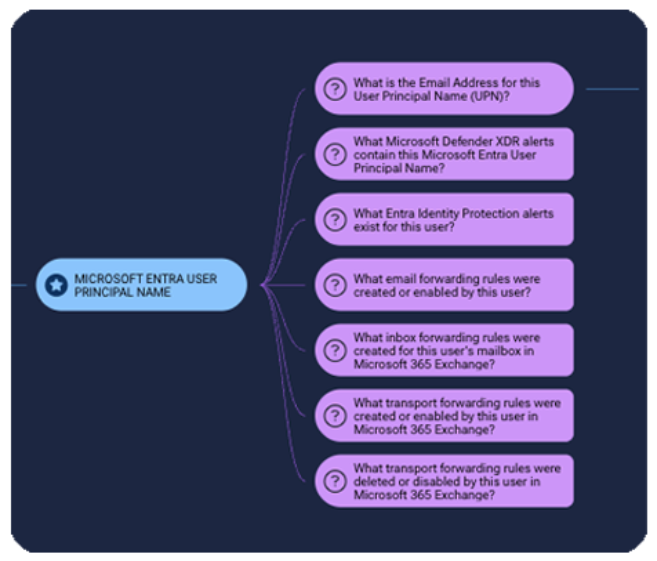
Facets are pre-engineered question sets for specific use cases that Command Zero makes available to your team. They solve the "blank page" problem that often paralyzes inexperienced analysts during a crisis. Instead of guessing where to start, an analyst can activate a specific Facet—such as "Suspicious PowerPoint Analysis" or "Impossible Travel Investigation"—and the system instantly populates the investigation with the critical questions a veteran hunter would ask. Facets ensure that expert methodology is baked into the tool, standardizing excellence across the SOC and ensuring no angle is overlooked.
Facets are useful for all analysts as no single analyst can be an expert in all data sources. Being able to level the playing field for everyone can lower the barrier of entry and deliver quality outcomes at every analysis.
Breaking the Silos: The Universal Translator
The modern enterprise IT and security can be best described as a Tower of Babel. Your endpoint data speaks one language; your Identity provider speaks another; your cloud logs speak a third. Historically, investigating a single thread across these silos required a Rosetta Stone of technical knowledge that took years to acquire.
This is why Tier 1 analysts escalate so often—they might simply not know the syntax to check the cloud logs.
Natural Language is the universal solvent for these silos.
When an analyst asks, "Did this user login from an unusual location?" they shouldn't need to know if the answer lies in Okta, Azure AD, or a firewall log. The Autonomous SOC architecture handles the translation, fetching the data from disparate sources and presenting the answer, not the raw logs. This allows a junior analyst to traverse the entire infrastructure with the confidence of a veteran architect.
The Feedback Loop: How Your Questions Improve Future Analysis
Here is the hidden advantage of the Natural Language approach that few are talking about: It is the most efficient way to capture institutional knowledge.
In a traditional SOC, when a senior analyst runs a brilliant, complex SQL query to catch a threat, that knowledge dies in the terminal history. It is rarely captured or reused. In a Question-Based environment, every interaction feeds the model.
- The Analyst asks a question: "Check for lateral movement via SMB."
- The platform executes the investigation: It retrieves the data and presents a verdict.
- The Analyst validates the result: They accept or reject the finding.
- Past investigations guide best practices: The platform learns from the investigation paths, questions asked and the analyst feedback about the verdict.
This interaction creates a Reinforcement Learning from Human Feedback (RLHF) loop. The system learns which questions yield results in your specific environment. It learns that lateral movement in your network usually involves specific subnets or service accounts.
"We don't want to assume that a large language model is more intelligent than [analysts] are, because it isn't... We need to marry up autonomous decision making and user-led investigations to achieve outcomes you couldn't get before."
— Alfred Huger, Co-Founder & CPO, Command Zero
The 2026 Standard for AI SOC
We are entering a year where the volume of alerts will finally surpass the human capacity to query them manually. The legacy Tier 1 analyst of 2025—who spent their day triaging alerts and writing basic queries—is functionally extinct.
The Tier 1 Investigators of 2026 and beyond is different. Armed with natural language and guided by Facets, they can pivot across data silos, audit AI decisions, and close complex cases that previously required a Tier 3 escalation.
This year, let’s make a resolution to get the peak performance out of every analyst, junior or senior. Stop forcing them to speak machine. Let them ask questions. The truth is waiting to be uncovered in the answers.
Ready to Ask Better Questions?
Give your SOC team the power of controlled autonomous flows and AI-assisted analysis. Book a demo to see how Command Zero empowers your team to close complex cases in minutes—not days—by turning natural language into autonomous action.